
Check out our Siblings Performances playlist on YouTube to watch full performances!
Have you ever called someone’s home and, for a moment, could not tell whether a mother, daughter or sister had answered the telephone? Relatives may not sound identical, but something in their tone, rhythm or way of shaping words can make the resemblance unmistakable. Sometimes a family voice gives itself away before the person does.
When siblings sing together, that resemblance can become something extraordinary.
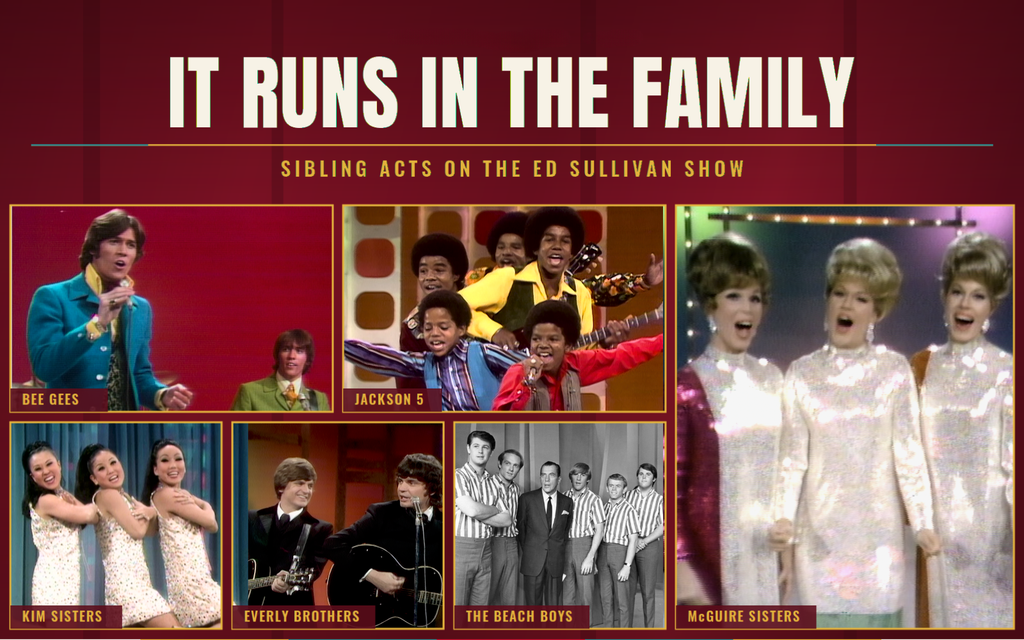
Throughout its historic run, The Ed Sullivan Show welcomed many of popular music’s greatest sibling and family acts, including The Everly Brothers, The McGuire Sisters, The Bee Gees, The Jackson 5, The Beach Boys, The Carpenters and The Kim Sisters. Their styles varied widely, but many possessed voices that naturally belonged together, a musical language developed at home and an instinctive understanding of how the others would sing, move and respond.
A voice is shaped partly by inherited physical characteristics, including the vocal folds and the throat, mouth and nasal passages through which sound travels. Siblings may therefore share a similar tone or texture. But genetics is only part of the story. They also grow up hearing the same accents, speech patterns, records, religious music and household expressions. They may pronounce vowels similarly, emphasize the same syllables and breathe or pause in the same places.
Sibling singers can begin with related vocal instruments shaped within the same musical environment.
That matters because harmony involves more than singing the correct notes. Singers must also match how they pronounce words, enter a phrase and release its final syllable. Brothers and sisters who have performed together since childhood may make those adjustments almost automatically.
Few acts illustrated this better than The Everly Brothers. Don and Phil Everly began performing as children and developed the close two-part harmony that helped shape early rock and roll. Phil generally sang the higher line and Don the lower, but their tones were so compatible that the two parts could sound like one expanded voice. They also knew the smallest details of each other’s delivery, where the other would breathe, how he would approach a note and how long he might hold it.
Christine, Dorothy and Phyllis McGuire achieved a similar unity in three-part harmony. The McGuire Sisters matched not only pitch but also the shape of their words, entrances and endings. Years of disciplined performance refined that natural connection until the sisters seemed to breathe and phrase as one. Their popularity made them Sullivan favorites, appearing on the program 22 times.
Yet siblings do not have to sound identical to sound as though they belong together. In The Bee Gees, brothers Barry, Robin and Maurice Gibb each had a recognizable sound. Barry was often commanding, Robin’s trembling delivery was unmistakable and Maurice helped anchor the harmonies. Their differences gave the group dimension without erasing the family resemblance.
Sibling voices can be like sibling faces: the individual features differ, but the relationship is still recognizable. Even a rasp, unusual vibrato or unconventional way of approaching a note can work within a related blend. When those qualities complement one another, what might otherwise be considered an imperfection can become part of the group’s signature.
The Beach Boys expanded that family sound through their intricate vocal arrangements. The classic lineup included brothers Brian, Carl and Dennis Wilson, their cousin Mike Love and family friend Al Jardine. Although their voices were not identical, they shared enough tonal similarity to blend naturally. What truly set the group apart, however, was Brian Wilson’s genius for understanding the individual range, tone and strengths of each voice, especially those of his brothers and cousin. He knew exactly who should carry the high, middle and lower parts and arranged them with almost architectural precision, creating the group’s signature sound. The Beach Boys showed that shared tone may help singers fit together, but arrangement and musical judgment determine what those voices ultimately become.
For The Jackson 5, sibling familiarity could be heard and seen. Jackie, Tito, Jermaine, Marlon and Michael Jackson sang, danced and moved with remarkable precision. Michael’s lead commanded attention, but the group’s sound and energy also depended on his brothers supporting his vocals, reinforcing the rhythm and moving in tight coordination around him.
That unity came from intense rehearsal, but also from the kind of understanding that develops when siblings grow up under the same roof. Years of watching, listening to and anticipating one another allowed a glance, an inhale or a slight change in posture to communicate onstage what only siblings might understand without words.
Family roles can also shape a group. One sibling may become the lead, another the arranger and another the steady instrumental foundation. Those roles can create stability, but they can also cause conflict when relatives compete for attention or try to establish separate identities.
The Bee Gees provide a clear example. Barry and Robin both sought the lead-singer role in the group’s early years. “Robin was really competitive with me,” Barry later recalled. When Barry emerged as the principal frontman, Robin temporarily left to pursue a solo career.
The rivalry strained their relationship, but it also helped define their contrasting musical identities. Barry became the group’s dominant lead, Robin developed a delivery that could not easily be mistaken for anyone else, and Maurice contributed as a singer, instrumentalist and arranger. Their differences could pull them apart personally, but they made The Bee Gees more dynamic when the brothers worked together.
The Everly Brothers experienced a similar contradiction. Don and Phil’s relationship eventually deteriorated even though their voices remained almost perfectly suited to each other. It is one of the paradoxes of sibling groups: people can communicate effortlessly in music while struggling to find the same harmony away from the microphone.
Still, competition is not always destructive. A sibling can be both a collaborator and a demanding judge, someone willing to say that a note is wrong, a lyric is weak or an arrangement is not working. That honesty, along with the desire not to remain in another’s shadow, can push each member to make a stronger contribution.
Not every sibling partnership depended on matched voices. Karen and Richard Carpenter represented another form of musical understanding. Karen possessed one of the most recognizable voices of her generation, while Richard knew how to arrange around it, when to add harmony, when to let the instrumentation expand and when to leave her nearly exposed.
That may be one of the deepest forms of sibling collaboration: understanding not simply how to sing beside someone, but how to leave exactly the right amount of space for that person to be heard. A modern parallel can be found in Billie Eilish and her brother Finneas, who similarly writes and produces around the qualities that make his sister’s voice so individual.
Musical chemistry among relatives could also help performers cross cultural boundaries. The Kim Sisters, biological sisters Sue and Aija and their cousin Mia, combined harmony, choreography, comedy and a command of numerous instruments. Appearing in American living rooms after the Korean War, they gave many viewers a new image of Korean performers while singing songs audiences already knew. Their visible bond made them immediately relatable, and their versatility led to more than 20 appearances on The Ed Sullivan Show.
The Chambers Brothers; George, Willie, Lester and Joe showed that sibling blends did not have to be polished or delicate. Raised singing in the church, they brought the call-and-response traditions of gospel into soul, blues and psychedelic rock.They showed that blending did not require smoothing away every individual.
But not every act with family ties was marketed as a “sibling group.” Gladys Knight & the Pips included Gladys, her brother Merald “Bubba” Knight and their cousins William Guest and Edward Patten, while Gerry and the Pacemakers featured Gerry Marsden alongside his brother Freddie. Sullivan also welcomed identical twins The Kessler Twins and countless other sibling acts, including The Berry Sisters, The Andrews Sisters, The Ames Brothers, The Kane Triplets, The Lennon Sisters and The Cowsills, and the list goes on.
The appeal of these acts was never purely musical. Once viewers knew the performers were related, they looked for similarities in their faces, voices, gestures and personalities. They noticed who led, who watched the others and who seemed determined to stand apart.
A family act came with a story already built in. Audiences could imagine the childhood rehearsals, arguments, shared influences and parents who first recognized the talent. Even when those details were unknown, the relationship gave each performance an emotional history.
Ed Sullivan understood that appeal. The Ed Sullivan Show was a family program, watched together in living rooms across America, and family acts were a natural fit for its stage. Sullivan had a keen eye for performers whose talent came with a personal story, brothers, sisters and relatives whose shared history was visible in the way they sang, moved and supported one another. Whether presenting the close harmonies of sisters, the synchronized energy of brothers or a group built around one unforgettable lead singer, he gave audiences the chance to see those connections become part of the performance.