
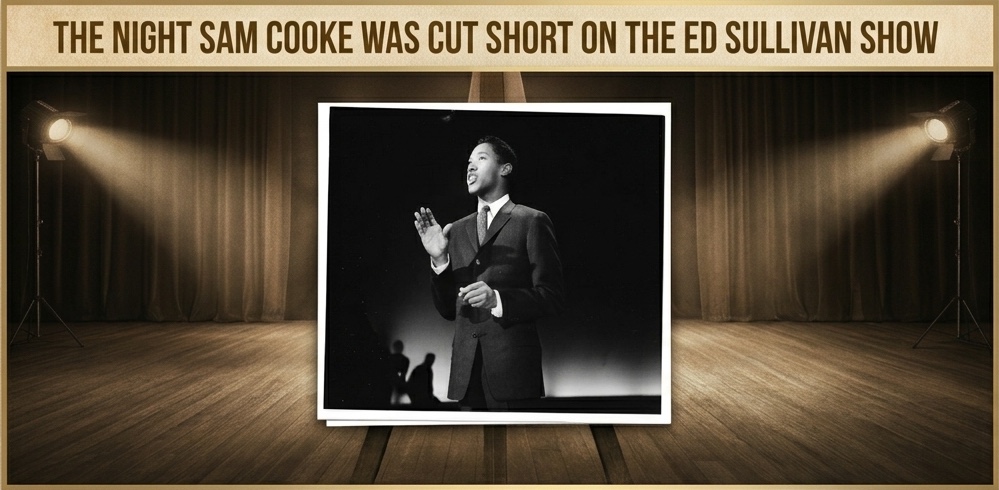
Sam Cooke had barely begun singing “You Send Me” on his first appearance on The Ed Sullivan Show when the live broadcast abruptly cut him off.
It was November 3, 1957, and Cooke had been booked near the end of the program. By the time Ed Sullivan introduced him, the show was already running long. Cooke stepped out, began the song that was quickly making him a star, and before he could get much further, the program ran out of time and the broadcast cut away.
Viewers were not happy.
Complaints poured into the show from people who had tuned in to see Cooke and had barely gotten the chance to hear him sing. Sullivan responded quickly, bringing Cooke back just four weeks later and making sure he had another opportunity to perform for the audience that asked to see more.
When Cooke returned on December 1, Sullivan made a point of letting him know that this time he would get his moment.
Sullivan turned to him and said, “Sam, here’s the time.”
Cooke then performed “You Send Me” without interruption, finally giving the audience the performance they had missed the first time around.
Later in the broadcast, Sullivan brought Cooke back onstage and addressed the earlier mishap directly.
“I did wrong one night here on our stage,” he told the audience. “And I never received so much mail in my life!”
It was a rare and candid acknowledgement, and it gave Cooke’s return an added sense of occasion. This was no longer simply another television booking for a singer with a hit record. The audience had asked for him back, Sullivan had listened, and now Cooke had the stage to himself.
He followed with “(I Love You) For Sentimental Reasons,” the performance viewers can still watch today. Cooke needed very little to hold the audience’s attention. His relaxed delivery, smooth phrasing and natural ease in front of the camera made the performance feel intimate, even on national television.
That quality was becoming central to his appeal. “You Send Me” was already climbing the charts before Cooke returned to The Ed Sullivan Show, but the timing of the appearance could hardly have been better. Soon after the December 1 broadcast, the song reached No. 1, adding even more momentum to his rapid rise.
What began as an unfortunate live television cutoff ultimately gave Sam Cooke something even more valuable: a second chance with an audience already waiting for him.
That return turned a frustrating television mishap into one of the more memorable comeback moments in the show’s history. Cooke came back with the attention firmly on him, and this time viewers got the chance to see exactly why they had wanted him back.