Revisit Elvis Presley’s unforgettable Ed Sullivan Show performances in HD with our YouTube playlist here.
Seventy years ago this September 9, Elvis Presley made his first appearance on The Ed Sullivan Show, a broadcast that shattered television viewership records and marked a defining moment in his rise to superstardom.
That rise had been unfolding at remarkable speed. By the fall of 1956, the 21-year-old performer who would soon be known as the “King of Rock and Roll” was quickly becoming one of the biggest names in entertainment. His records were topping the charts, his television appearances were drawing enormous audiences, and the uninhibited way he moved onstage had made him a sensation among teenagers while alarming many of their parents and older viewers.
Still, The Ed Sullivan Show offered Elvis something few other programs could, access to an enormous audience that crossed generations. Millions of Americans who had spent months hearing about the young singer and the controversy surrounding him would now have the chance to see him for themselves.
As we mark the 70th anniversary of that first appearance, we look back at the unlikely road that brought Elvis to Sullivan and the unusual circumstances that made the September 9 broadcast such a remarkable moment in television history.
Getting there, however, was anything but guaranteed.
By the time Sullivan entered the picture, Elvis had already spent much of 1956 making his way onto national television. A string of appearances on the Dorsey Brothers’ Stage Show introduced him to viewers across the country, followed by appearances on The Milton Berle Show that brought even more attention, and controversy. With each performance, Elvis was becoming harder to ignore.
Ed Sullivan, however, was not immediately convinced. His Sunday-night program was built around an enormous family audience, and with so much controversy now surrounding Elvis, he did not seem like a natural fit for the show.
Then came July 1, 1956.
That night, Elvis appeared on NBC’s The Steve Allen Show, which aired directly opposite Sullivan. Allen famously put him in a tuxedo and tails and had him sing “Hound Dog” to a basset hound, deliberately presenting the singer in a far more restrained fashion than the performances that had caused so much commotion. The gimmick may have limited Elvis on stage presence, but it did nothing to diminish his drawing power. Restrained or not, viewers wanted Elvis, and the ratings proved it. On July 1, Steve Allen did something few competitors managed to do, he beat Ed Sullivan in the ratings.
The famously competitive Sullivan responded the next day with a teasing telegram addressed to “Steven Presley Allen,” calling him a “stinker.” But beneath the joke was a reality that was becoming difficult to ignore, Elvis could deliver an audience.
Not long afterward, Sullivan and Elvis’s manager, Colonel Tom Parker, reached an agreement: Elvis would make three appearances on The Ed Sullivan Show for a total of $50,000, an extraordinary sum for television at the time, and reportedly the highest amount yet paid to any performer for a television appearance. An impressive measure of just how quickly Elvis’s value was rising.
His first Sullivan appearance was set for September 9, but in the weeks leading up to the broadcast, the evening began to take on an unexpected shape.
About a month before Elvis was scheduled to appear, Ed Sullivan was seriously injured in an automobile accident in Connecticut. The crash left him with a fractured rib along with chest and facial injuries, and his recovery meant that when September 9 arrived, the host of The Ed Sullivan Show would not be Ed Sullivan at all.
In his place, British actor and Academy Award winner Charles Laughton stepped in as guest host in New York. But even that was only part of what made the broadcast unusual, because Elvis would not be in New York either.
By then, Elvis’s career had already moved beyond records, concerts and television. He had arrived in Hollywood on August 16 to begin work on his first motion picture for 20th Century-Fox, and filming began six days later on a Civil War-era drama then titled The Reno Brothers. Elvis was playing Clint Reno alongside Richard Egan and Debra Paget, and production continued straight through September.
So when the date of his Sullivan debut arrived, Elvis was still in the middle of filming nearly 3,000 miles away in Los Angeles.
Rather than pull him out of production and bring him across the country, The Ed Sullivan Show did something that added another layer to an already unusual night, it brought the broadcast to Elvis.
From the New York studio, Laughton turned the program over to the West Coast, “And now, away to Hollywood to meet Elvis Presley!”
With that, the screen shifted from New York to CBS Television City in Los Angeles.
It is an easy transition to take for granted now, in an era when live television can move instantly between cities and continents. In 1956, however, coast-to-coast network broadcasting was still relatively new. That Sunday night, one of television’s biggest programs was unfolding from opposite ends of the country at once; Laughton hosting in New York, Elvis performing live in Hollywood, and millions of viewers watching it all come together as a single broadcast.
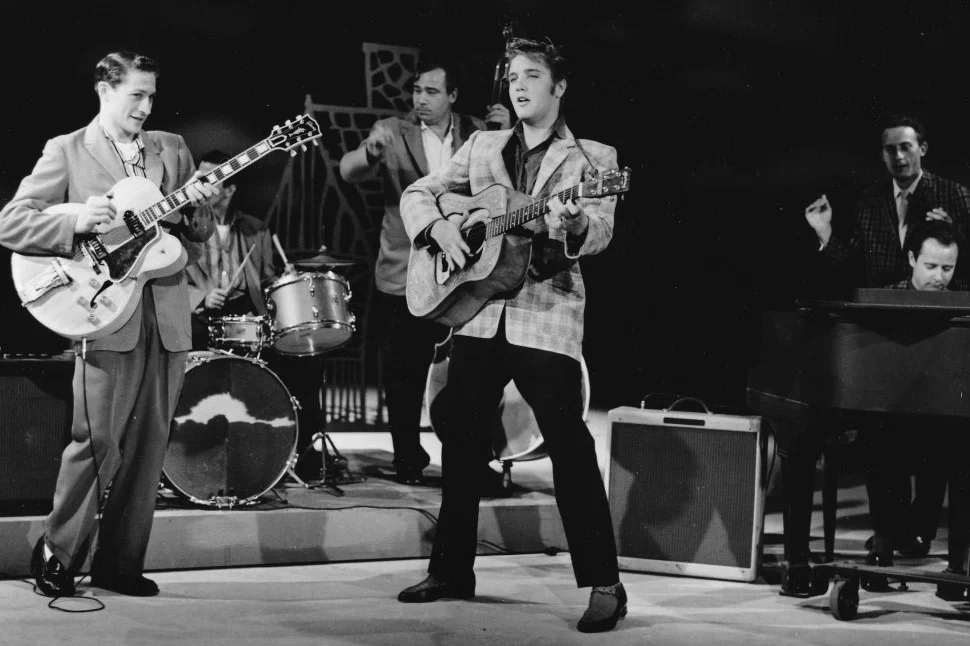
When the cameras found Elvis in Los Angeles, he was wearing a plaid jacket and was backed by Scotty Moore, Bill Black, D.J. Fontana and The Jordanaires. He opened with “Don’t Be Cruel,” and the reaction from the Hollywood audience was immediate.
Then, almost as quickly as he had stirred up the room, Elvis changed the mood.
He introduced a new ballad called “Love Me Tender,” recorded in Hollywood only weeks earlier, on August 24, for the film he was making. The record had not yet been released, which meant that millions of viewers were hearing the song before they even had the chance to buy it.
For a song still weeks away from reaching record stores, there could hardly have been a bigger introduction.
“Love Me Tender” soon generated enormous advance interest and went on to become a No. 1 hit. Its impact extended beyond the record itself. The film Elvis had been shooting under the title The Reno Brothers would soon take the song’s name as well. The American Film Institute notes that after Elvis performed “Love Me Tender” on The Ed Sullivan Show, 20th Century-Fox decided to retitle the picture.
By the time Elvis returned later in the broadcast that September 9th, the pace shifted again. He launched into Little Richard’s “Ready Teddy,” paused to wish Ed Sullivan a speedy recovery, and then closed with the song that had already become inseparable from the controversy surrounding him, “Hound Dog.”
Earlier performances of “Hound Dog” had helped fuel the national debate over Elvis’s movements onstage. Now he was performing it before the largest television audience he had ever faced.
Inside CBS Television City, the screams made the audience’s reaction unmistakable.
Outside the studio, the numbers would tell an even bigger story.
An estimated 60 million people watched Elvis Presley on The Ed Sullivan Show that evening, approximately 82 percent of the television viewing audience and the largest single television audience in history at that time. Put against the size of the country, the figure becomes even more striking. The population of the United States in 1956 was approximately 168 million, meaning that roughly one out of every three Americans was watching.
Even in an era with fewer television channels and much larger network audiences, that kind of reach was extraordinary. But the significance of the Sullivan audience was not simply how many people were watching. It was the range of people watching together.
Sunday night television was still a family ritual, and The Ed Sullivan Show was built for exactly that kind of audience. In the course of a single broadcast, viewers might see an opera singer, a comedian, a Broadway cast, an acrobat and a rock and roll performer. Teenagers were watching alongside their parents and grandparents, often from the same living room.
For Elvis, that meant reaching well beyond the young fans who were already buying his records and following his every appearance.
For many Americans, September 9 was their chance to see for themselves the young singer who had spent much of 1956 dominating headlines and provoking debate. A teenager who already knew every word to “Hound Dog” might have been sitting beside a parent who knew Elvis primarily from newspaper stories about his supposedly scandalous performances.
Now they were both watching the same screen.
That was one of the particular powers of The Ed Sullivan Show. It did not simply introduce performers to an audience; it placed them in front of multiple generations at once, turning a popular entertainer into a shared national experience.
Elvis came to the broadcast already famous.
By the end of the night, much of America had seen exactly why.
Elvis Presley would return to The Ed Sullivan Show twice more, on October 28, 1956, and January 6, 1957, adding more memorable television moments to a year already crowded with them.
But there is something about the first appearance that remains singular.
At 21, Elvis was still only at the beginning of what would become one of the most extraordinary careers in popular music. Yet so much of what would come to define him was already there, the unmistakable voice, the movement, the charisma and a sound deeply indebted to Black rhythm and blues, gospel and Southern musical traditions that had surrounded him growing up in Mississippi and later Memphis. Those influences were central to the music he absorbed and the performer he was becoming.
He looked and sounded different from many of the performers American television audiences were accustomed to seeing. There was a looseness to the way he moved, an intensity in the way he delivered a song and a blend of musical influences that made him feel new to a mass audience, even when many of those sounds had much deeper roots.
What followed would make the scale of that early promise almost unimaginable. Elvis became the “King of Rock and Roll,” sold hundreds of millions of records, starred in more than 30 films and became one of the most recognizable figures in entertainment. His influence stretched well beyond his own recordings, shaping generations of performers and leaving an imprint on music and popular culture that remains visible today.
That history gives the September 9 performance a different weight when viewed 70 years later. There is something remarkable about watching Elvis before the legend had fully formed, before decades of hit records, films, Las Vegas, the jumpsuits and the imagery that would eventually become inseparable from his name.
Here, he is simply 21-year-old Elvis Presley, still in the midst of an extraordinary rise, with most of his story yet to be written. Seventy years later, we know where that story leads. But on September 9, 1956, America was watching it unfold in real time on The Ed Sullivan Show.